

Henry Ford didn’t invent the automobile. If you’ve ever participated in pub trivia or looked beneath a Snapple cap, you probably know this. What Henry Ford did do was mold our modern conception of what an automobile could and should be.
As the Industrial Revolution faded and left us with a new world to experiment with, the Ford Motor Company helped pave the road ahead with game-changing inventions and innovations. From establishing contemporary practices of mass production and employee benefits to introducing safe-driving features such as blind spot technology, Ford has always been at the forefront of cutting-edge thinking.
Today, Casa Ford takes a closer look at five of the most consequential ways Ford has changed the landscape of the auto industry.
Moving Assembly Line & Mass Production
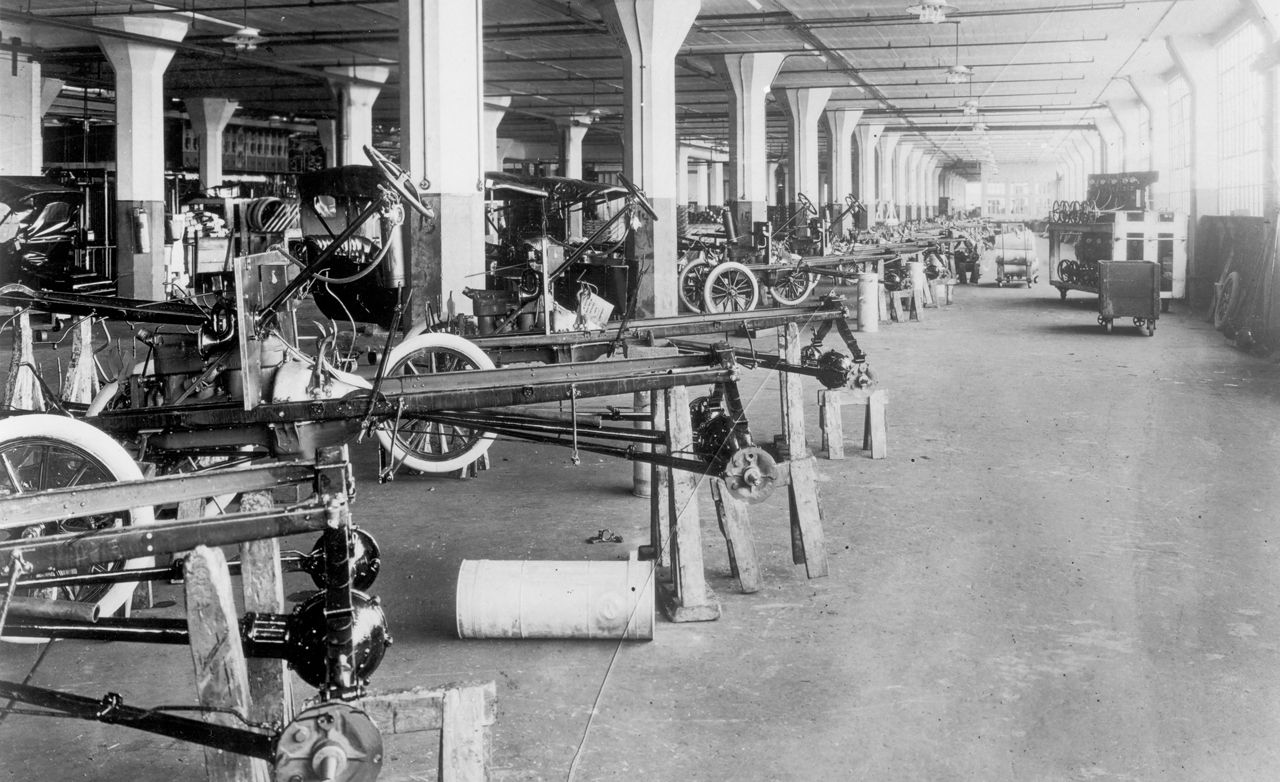
Automobile manufacturing would never be the same following Ford’s implementation of the moving assembly line. By using a conveyor belt, Ford assembly plants efficiently moved the product to the worker, rather than employees scramble around facilities. After much trial and error, the process was perfected at the Highland Park assembly plant in 1913. Soon, new Ford automobiles were being fully assembled in just 90 minutes.
In addition, Ford introduced standardization, which reduced production costs and increased efficiency by utilizing standardized parts that could be shared across different models.
Model T
The original automotive game-changer for consumers, the Ford Model T was mass produced from 1908 to 1927. In that span, it established itself as the first mass-affordable automobile, resulting in car travel becoming available to middle-class America. Thanks to savings stemming from mass production and standardization, the average price of the Model T dropped from $780 in 1910 to $290 in 1924 – a truly staggering number, especially when adjusted for inflation.
Thanks to the moving assembly line and its interchangeable parts, the Model T (also known as “the Tin Lizzie”) became the most ubiquitous vehicle in the world by an absurd margin. By the early 1920s, more than half of registered automobiles throughout the world were Fords, with over 15 million Model T’s built and sold during that span.
$5 Wage / 5-Day Workweek
When Henry Ford proposed in 1914 that all Ford employees be compensated at five dollars per workday, it sent a shockwave through the working community – and for good reason. Five dollars per day translates to $153 per day by today’s standards, after adjusting for inflation. That’s good for $19 an hour, well above the stagnant federal minimum wage of $7.25.
Then, in 1926, Ford introduced another now-standard workplace practice with the five-day workweek. Though it was driven by the expectation that worker productivity would increase if given more leisure time, Ford also believed giving workers more time to purchase and consume goods would be good for business. The idea passed the test of time; nearly a century later, some companies are starting to explore expanding Ford’s vision and bumping the workweek down to four days.
The Trimotor Plane
One of the great “What If’s” in automotive history is the Ford Airplane Division, which shut down in 1933 due to the Great Depression. When Ford entered the aviation business during World War I, they introduced the Trimotor Plane, an aptly-named, three motor plane that became the United States’ first successful passenger airliner.
You can’t help but wonder what Ford could have further accomplished in the aviation space if they hadn’t been forced to shutter the division in the mid-1930’s. Unfortunately, in this case, the sky was literally the limit.
Blind Spot Monitoring
For decades, drivers changed lanes with the aid of three rear mirrors and their own intuition. That changed with the introduction of Ford’s BLIS (Blind Spot Information System). BLIS is responsible for detecting vehicles in your blind spot and alerting you to their presence. It has since paved the way for a plethora of modern collision-avoidance technology.
While Volvo was technically the first manufacturer to introduce this feature to the public, Ford’s 1995 concept car, the GT90, was the first vehicle fitted with modern blind spot technology. Ford unveiled its version of blind spot monitoring to a mass audience in 2009 with the 2010 Ford Fusion and Fusion Hybrid.
Drive Into a New Future
Ford’s innovative nature hasn’t diminished; currently, it’s focused on expanding the reach of EV technology. With plans to put over 40 EVs and hybrid models on the road within the next few years, Ford’s next step is the complete electrification of its fleet.
You can get in on the EV action early when you shop at Casa Ford. Explore the Mustang Mach-E, an electric SUV with an EPA-estimated range of 310 miles. Or dig in to the electrified version of the F-150, the Ford F-150 Lightning. That said, no need to worry if you’re still committed to your gas-powered Ford. Our Service Department is here to handle your oil filter replacement, brake repair, and whatever else you need to drive into a bright, boundless future.
Connect with us


- February 2025
- January 2025
- December 2024
- November 2024
- October 2024
- September 2024
- August 2024
- July 2024
- June 2024
- May 2024
- April 2024
- February 2024
- January 2024
- December 2023
- November 2023
- October 2023
- August 2023
- July 2023
- June 2023
- May 2023
- April 2023
- March 2023
- February 2023
- January 2023
- December 2022
- November 2022
- October 2022
- September 2022
- August 2022